← Back to Articles

Article

Finding Your Creative Oasis

Why I went looking for room to draw, paint, and write, and what John Cleese and Guy Claxton helped me reconsider about design leadership.

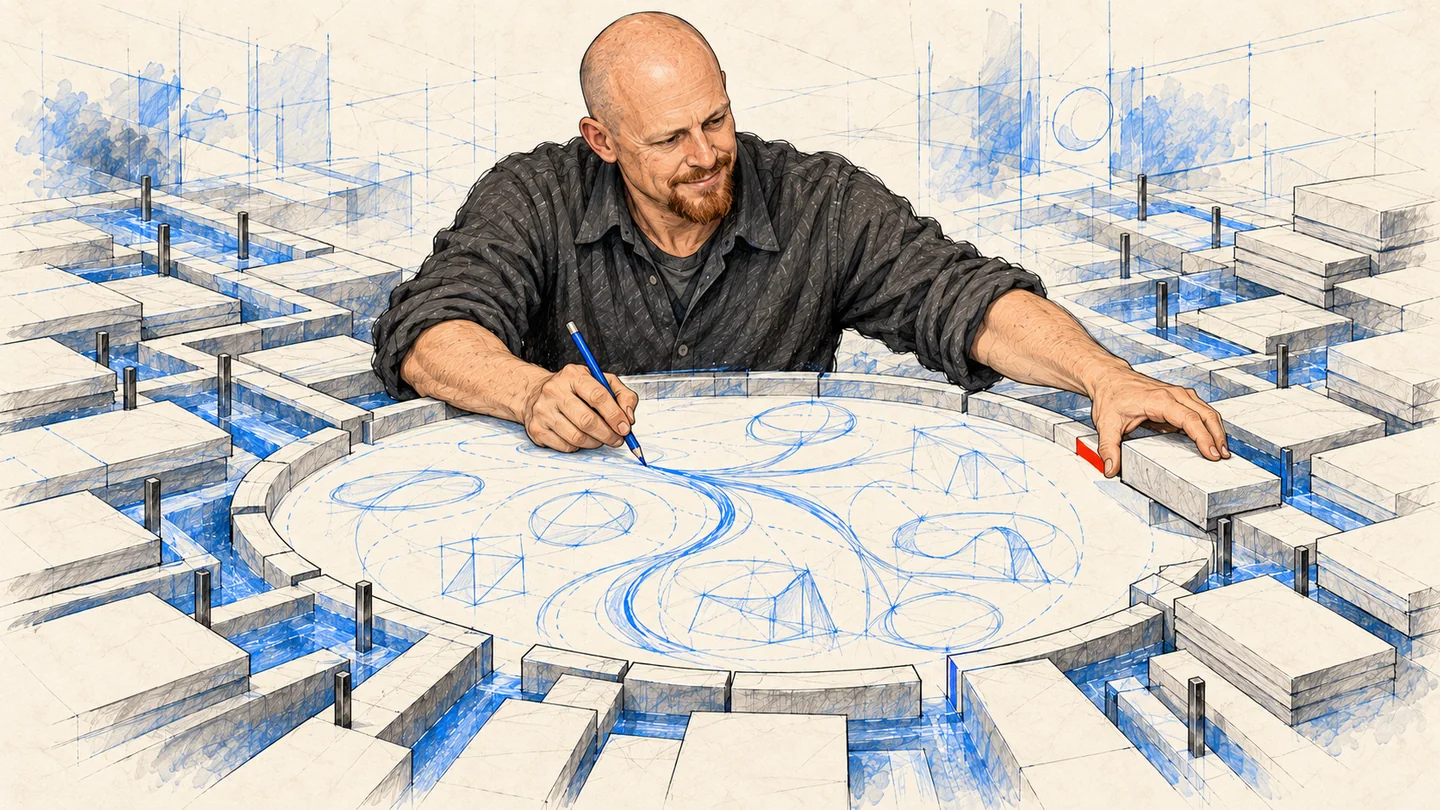
David clears a space within a rigid system to explore unfinished ideas before judging them.

Year

2026

Topics

Design Leadership · Creativity · Team Operating Models

Format

Leadership perspective

Make room for the thinking that a busy week crowds out

I started looking for a creative oasis because I wanted to find my way back to drawing, painting, and writing. Work and family filled most of my time, and even when I sat down to make something, I kept approaching it like another task to finish. I wanted some room to play again.

Then I came across John Cleese talking about creativity. I went looking for more of his talks because he made the problem feel practical: give yourself a place, some protected time, and permission to stay with an unfinished idea. That was useful to me as a person who wanted to create, and it gave me something to think about as a design leader.

We can ask a team for original thinking while filling its week with interruptions and asking for a decision at every review. My interest in a creative oasis starts there. What would we need to change so people actually have room to explore?

Cleese gave me a useful way to separate exploration from execution

In the talks linked below, Cleese describes an open mode for playful exploration and a closed mode for getting things done. Both have a purpose. An idea needs room to develop, and a team eventually needs to choose a direction and deliver it.

What interested me was the timing. If every sketch is treated as a commitment, exploration becomes an exercise in defending the safest answer. If we keep reopening a decision after implementation begins, delivery becomes unstable. The useful question is whether we are asking people to explore or to execute, and whether the meeting makes that expectation clear.

Guy Claxton's Hare Brain, Tortoise Mind was another influence on my thinking. It encouraged me to take less hurried thinking seriously. I do not treat Claxton's account and Cleese's modes as interchangeable frameworks. What I take from them is a reason to leave space for a problem to develop before demanding an answer.

A creative oasis needs boundaries people can respect

One way I make that room is to leave my office and sit outside under a tree or in a comfortable reading area at home. In Phoenix, the reading area wins during summer. The point was to step away from the place where I was always responding to something.

At work, that might mean closing a door, using a quiet room, or protecting time on a calendar. It also means resisting the temptation to check one more message. A different room does very little if the same interruptions follow you into it.

I find the combination of space and time helpful: a clear start, a clear finish, and an understanding that ordinary requests can wait. An emergency is an exception. If the building is on fire, I still want someone to tell me.

There is no required setting or guaranteed duration. Start with a boundary that is realistic enough to keep. Bring a question, a sketchbook, or an unresolved design problem. Let the session be useful without requiring a finished artifact at the end.

Confidence and humor make unfinished ideas easier to share

Cleese's emphasis on play stayed with me because an unfinished idea can be awkward to say aloud. Someone may see a problem with it immediately. That does not necessarily mean the idea has nothing to offer; it may need another angle or a connection we have not made yet.

For a team, I would make exploration explicit before the review begins. We still know the problem, the users, and the constraints. We are giving possibilities a chance to develop before ranking them. Questions such as "What else could this help us see?" keep the conversation moving without pretending every idea is equally useful.

Humor matters to me here too. Serious work can leave room for a laugh. The distinction I took from Cleese is between caring about the work and making every conversation solemn. Nobody needs to perform a comedy routine. People do need enough confidence to contribute something that is not polished yet.
Give the team a clear moment to choose

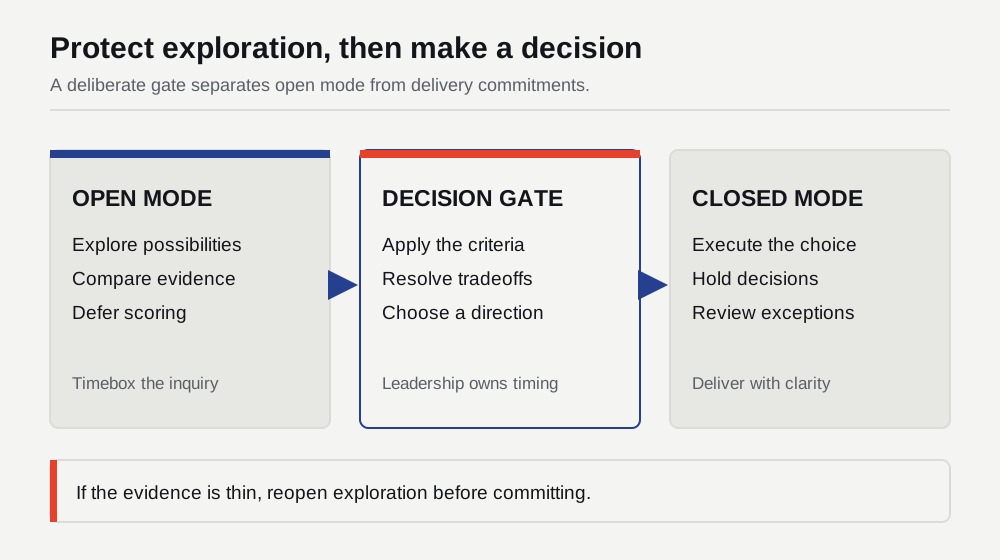
The leadership application is straightforward: agree on the problem and constraints, protect a bounded period of exploration, then make the decision with the evidence and tradeoffs in view. Deferring evaluation does not mean hiding the criteria until the last minute.

Before pushing for an answer, ask when the decision is actually needed. Some decisions cannot wait. Others have enough room for another comparison or a question to a user. Treat that room as a resource, then honor the commitment when it is time to act.

Explore within agreed constraints, compare evidence at a decision gate, then execute. Reopen the question when new evidence changes the choice.
My application to design reviews, informed by Cleese and Claxton: protect exploration, make the decision explicit, and reopen it when the evidence warrants it. This is a proposed operating model, not a measured team outcome. On a small screen, scroll the diagram or open it at full size.

Start by changing one review

I would begin with a review that routinely mixes early exploration and approval. Tell people which conversation they are coming to, what question needs attention, and what the session should produce. Keep the actual decision owner clear.

A practical sequence to try, rather than a claim about a past project
MomentQuestionUseful output
ExplorationWhat possibilities address the agreed problem?Options and questions worth investigating
DecisionWhich option fits the evidence and constraints?A direction, tradeoffs, and a named owner
ExecutionWhat needs resolving to deliver that choice?Implementation and validation; reopen for material new evidence

Protecting exploration does not promise a brilliant result every time. It gives people a fair chance to notice, connect, and question before committing. That is a more useful leadership responsibility than asking everyone to be creative on demand.

I came to this subject because I missed making things. That remains the reason I care about it. For me, the creative oasis is a way to make room for curiosity in a life that is already full, and a reminder to offer teams some of that room too.

The references behind this perspective

Cleese and Claxton helped me think about the conditions that give an idea room to develop. The review sequence above is my application of those influences to design work.